Shaping Your Outdoors. Surpassing Expectations.

Granite Falls Storm Cleanup
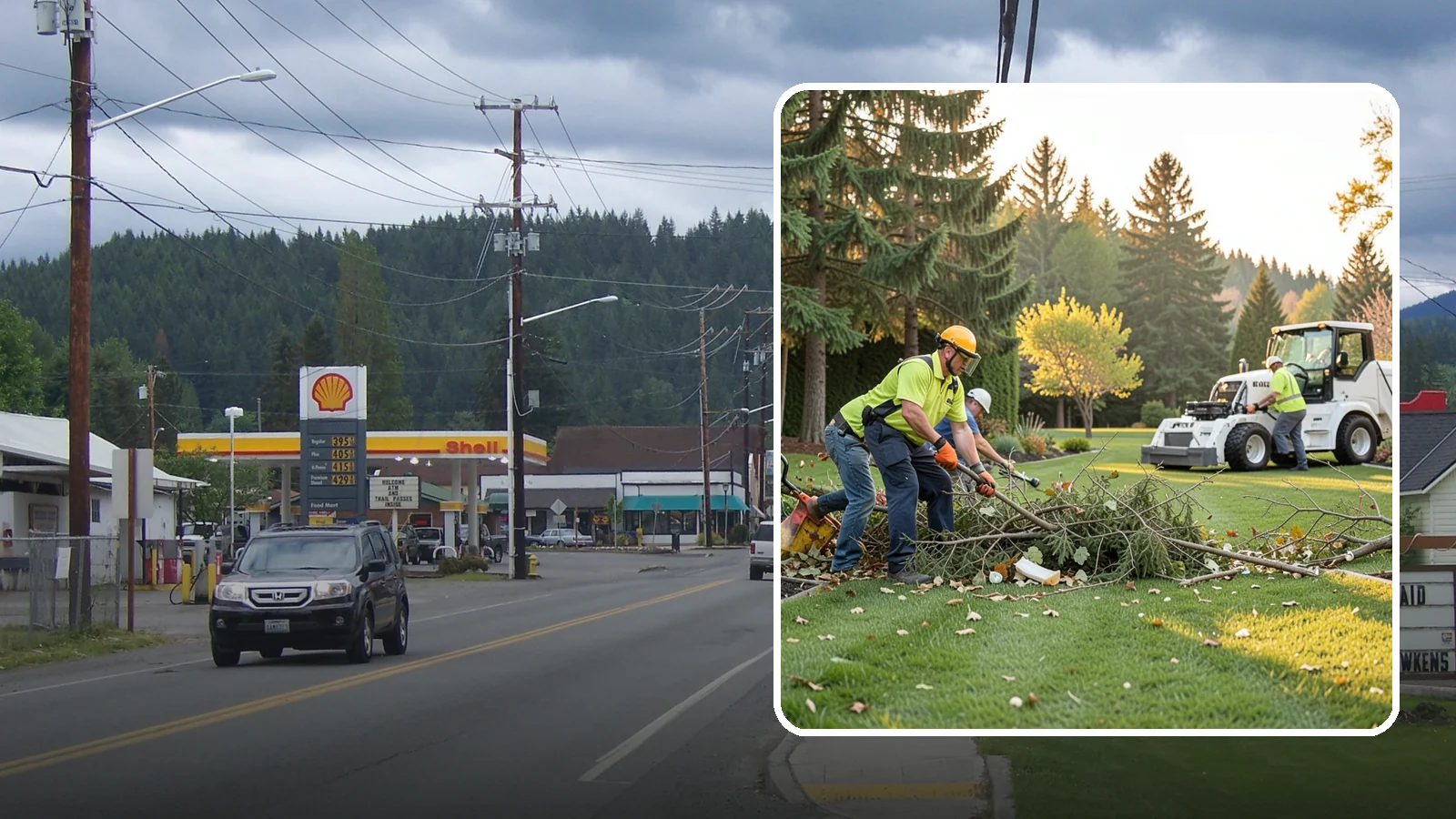
Fast cleanup of storm debris – downed branches, blown-down mess, and damage – to restore your property.
Storm cleanup in Granite Falls makes the most sense right after a big wind or rain event, and again in the wetter months when saturated ground makes limbs and trees more likely to come down. The city averages about 61.2 in of rain a year (Daymet, 2005-2025), so soaked soil is a regular part of the picture.
Washington Landscaping handles storm cleanup for homeowners who want fallen limbs, debris and damaged branches dealt with safely. We have an ISA Certified Arborist on staff, and we offer free estimates. Call or text 425-433-9444 to describe what you are seeing.
Planning Storm Cleanup in Granite Falls
Start by walking your yard from a safe distance. Note what is down, what is hanging, and what is touching a structure, fence or line. Take photos. Stay away from anything near power lines and call the utility instead.
What affects the scope
Tree canopy covers about 32.8% of Granite Falls (USFS/NLCD 2025). That is a city-wide figure, and your lot may have more or less shade. Still, it means many yards have large trees overhead, so a storm often leaves more than loose twigs. Size and number of fallen limbs, how far they must be hauled, and whether anything is lodged in a tree all change the work.
Hanging or split limbs are a separate issue from debris on the ground. Judging whether a damaged tree can be kept, pruned or should come out is where an arborist's eye helps. Our ISA Certified Arborist can assess that, so you are not guessing about a tree that looks stable but may not be.
Why the weather matters
Granite Falls sees only about 5.3 days a year with 1 in or more of rain, so heavy single-day rain is uncommon. When it does happen, it can be extreme: the wettest day from 2005 to 2025 brought 2.1 in on February 21, 2012. Ground that is already soaked is softer, which can affect how equipment moves across a lawn and how stable trees are afterward.
What to expect
We begin with a free estimate. We look at the damage, talk through what needs to go first, and explain the steps. Work is done by a licensed, bonded and insured company ($2M). If you want to spread the cost, financing is available subject to credit approval.
One practical tip: before anyone cuts anything, photograph the damage from several angles. Clear photos help with any insurance claim and make it easier for us to talk through the job with you.
Granite Falls yard conditions at a glance
| Tree canopy | 32.8% of the city |
|---|---|
| Land sloping 15% or more | 16% (40% or more: 3%) |
| Soil drainage (rated land) | 72% well, 21% moderately well, 7% poorly drained |
| Share of rain October to April | 79% |
A year in a Granite Falls yard
- Late winter
- Dormant pruning for most deciduous trees and shrubs, before buds break.
- Spring
- Last frost is usually around Mar 25; in 1 year in 10 it comes on or after Apr 14. Plant frost-tender annuals and vegetables after that.
- Early summer
- Check sprinklers and drip lines before July, the start of the dry months here.
- Summer
- July average 0.9 in. Water deeply and less often; mulch beds to hold moisture.
- Fall
- Aerate, overseed and plant trees and shrubs while the soil is warm; first frost is usually around Nov 9. Winterize irrigation before then.
- Winter
- About 44 days a year freeze at night and thaw by day: keep drains, paver joints and wall weep holes clear.
Dates are medians for the city from Daymet 2005-2025; your yard and any given year can differ.
How Granite Falls’s soils drain
- Well drained72%
- Moderately well21%
- Poorly drained7%
Share of rated land in the USDA SSURGO soil survey; built-over ground is not rated. A soil check on your lot tells you what you have.
Sources: Daymet daily weather (NASA/ORNL), 2023 USDA Plant Hardiness Zone Map data (PRISM, Oregon State University), USDA SSURGO soil survey, USGS 3DEP elevation, USFS/NLCD tree canopy 2025, US Census ACS 2020-2024.
Granite Falls Storm Cleanup
Local Service Information
Granite Falls
A small city at the edge of the Cascade foothills near the Mountain Loop Highway.
Benefits
Fast response after storms; Clears fallen limbs and debris; Prioritizes hazards and access; Removes damaged plant material; Prevents secondary damage
Process
Also serving Granite Falls
- Green waste hauling in Granite Fallsat Washington Tree Services
- Service Verification in Granite Fallsat Washington Snow Removal
Get a Free Storm Cleanup Estimate in Granite Falls
Tell us about your project. We’ll review your needs and provide a customized, no-obligation proposal.
Request a Free Consultation
Complete the form or call our team to discuss your project.
On-Site Assessment
We’ll review your property, discuss your goals, and recommend an appropriate solution.
Receive a Customized Proposal
Receive a detailed estimate outlining the proposed work and pricing.