Shaping Your Outdoors. Surpassing Expectations.

Hunts Point Pavilion Installation
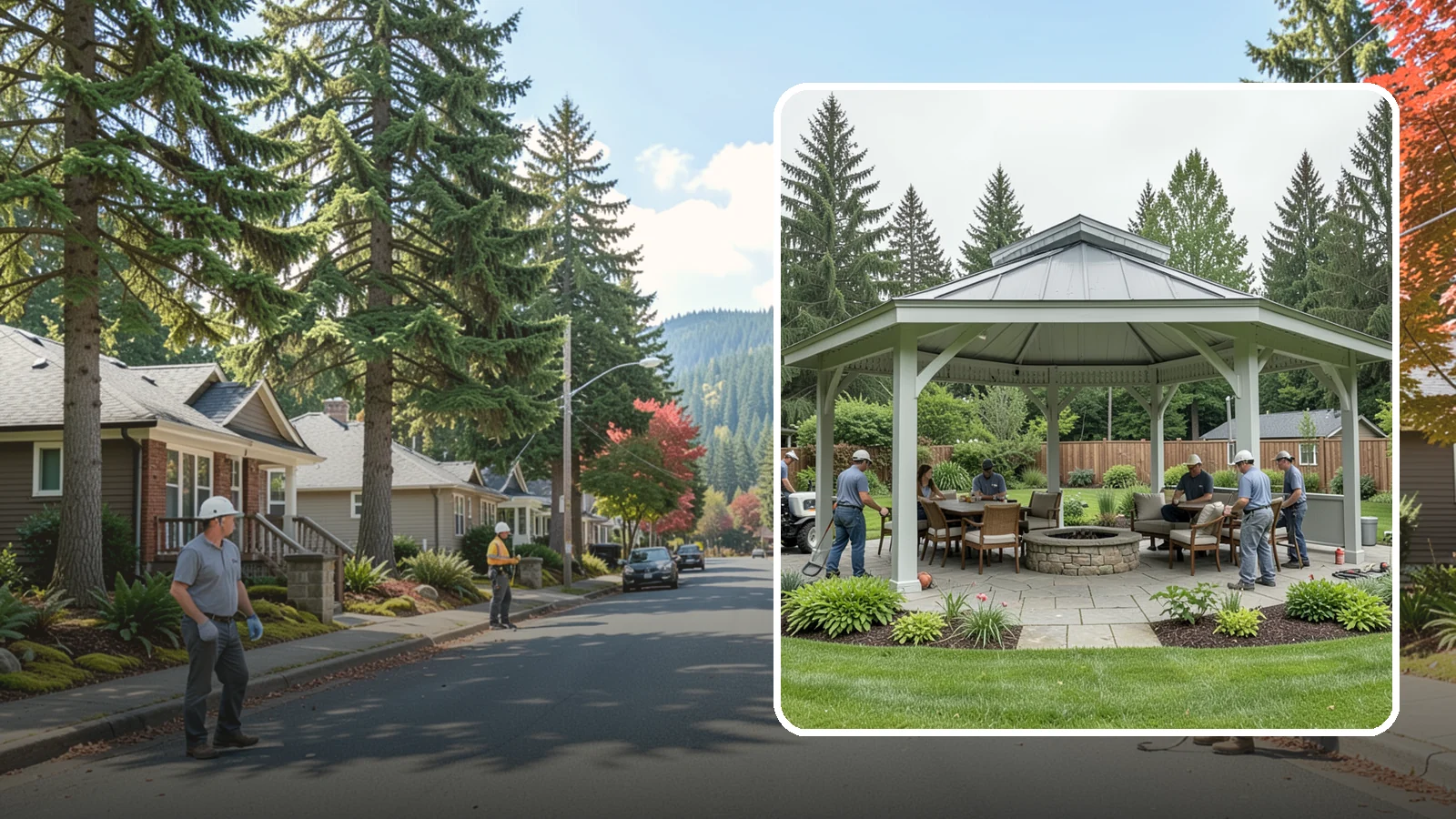
Solid-roof pavilions that create a substantial, fully sheltered outdoor room for gathering and dining.
The best window for building a pavilion in Hunts Point is July and August. Those are the only dry months here, with averages of about 0.56 in of rain in July and about 0.91 in in August (Daymet, 2005-2025). Footings need to be dug and concrete cured without standing water in the holes.
Planning can start well before that. Washington Landscaping, based in Bothell and in business since 2004, offers free estimates. Settling the design, the footprint and any city checks in spring means the build can begin when the weather turns dry.
Planning a Pavilion in Hunts Point: Rain, Cold and Scope
A pavilion is a roofed structure, so it is worth planning around the weather it will sit in. Hunts Point sees about 106 days a year with 0.1 in or more of rain (Daymet, 2005-2025). Much of the use of a pavilion happens in damp weather. That makes roof coverage, drainage and the floor surface matter more than they would in a drier place.
Planning
Start with where the pavilion will sit and what you want to do under it. Dining, a hot tub, an outdoor kitchen and a quiet seating area each call for a different size and different utilities. Think about how the roof will shed water, and where that water goes. Roof runoff should be directed away from the pavilion posts and from neighboring areas of your yard.
Because a pavilion is a structure, permit needs are checked with the city before work starts. We do not promise a permit outcome. Your lot, setbacks and the size of the structure all play a part.
What affects scope
Size and roof style are the largest factors. Footing depth, the slope of the site and the condition of the ground also change the work. Per the USDA, Hunts Point is in plant hardiness zone 9a, with an average coldest winter night of about 21.5 F (2023 map). That is mild, but wood and metal still need finishes suited to constant moisture. Your own yard may differ from city-wide numbers, especially if it is shaded, sloped or low.
Surrounding hardscape, such as a patio base or a path to the pavilion, can be part of the same project. Hardscaping work carries a 1-year workmanship warranty.
What to expect
The sequence is layout, excavation, footings, framing, roofing and finishing. Footings and concrete are the weather-sensitive steps, so they fit best in the dry stretch of July and August. We are licensed, bonded and insured ($2M). Financing is available, subject to credit approval.
One practical tip: before the build, walk the site during a heavy rain. Note where water pools or runs. It will show you where the pavilion floor and drainage need the most attention.
Hunts Point yard conditions at a glance
| Days that freeze at night and thaw by day | 28 a year |
|---|---|
| Land sloping 15% or more | 5% (40% or more: 0.1%) |
| Days with 0.1 in or more of rain | 106 a year |
| Soil drainage (rated land) | 0% well, 82% moderately well, 18% poorly drained |
| Elevation range | 16 to 68 ft |
A year in a Hunts Point yard
- Late winter
- Dormant pruning for most deciduous trees and shrubs, before buds break.
- Spring
- Last frost is usually around Mar 10; in 1 year in 10 it comes on or after Mar 30. Plant frost-tender annuals and vegetables after that.
- Early summer
- Check sprinklers and drip lines before July, the start of the dry months here.
- Summer
- July and August average 0.6 in and 0.9 in. Water deeply and less often; mulch beds to hold moisture.
- Fall
- Aerate, overseed and plant trees and shrubs while the soil is warm; first frost is usually around Nov 15. Winterize irrigation before then.
- Winter
- About 28 days a year freeze at night and thaw by day: keep drains, paver joints and wall weep holes clear.
Dates are medians for the city from Daymet 2005-2025; your yard and any given year can differ.
How Hunts Point’s soils drain
- Well drained0%
- Moderately well82%
- Poorly drained18%
Share of rated land in the USDA SSURGO soil survey; built-over ground is not rated. A soil check on your lot tells you what you have.
Sources: Daymet daily weather (NASA/ORNL), 2023 USDA Plant Hardiness Zone Map data (PRISM, Oregon State University), USDA SSURGO soil survey, USGS 3DEP elevation, USFS/NLCD tree canopy 2025, US Census ACS 2020-2024.
Hunts Point Pavilion Installation
Local Service Information
Hunts Point
A very small, exclusively residential town on a peninsula in Lake Washington.
Benefits
A fully sheltered outdoor room; Solid roof for any weather; Substantial, permanent structure; Options for lighting, fans, and heat; Centerpiece of outdoor living
Process

Pavilion Installation in nearby areas
Also serving Hunts Point
- Pavilion Construction in Hunts Pointat Washington Construction
- Paver Patio Cleaning in Hunts Pointat Washington Pressure Washing
Get a Free Pavilion Installation Estimate in Hunts Point
Tell us about your project. We’ll review your needs and provide a customized, no-obligation proposal.
Request a Free Consultation
Complete the form or call our team to discuss your project.
On-Site Assessment
We’ll review your property, discuss your goals, and recommend an appropriate solution.
Receive a Customized Proposal
Receive a detailed estimate outlining the proposed work and pricing.