Shaping Your Outdoors. Surpassing Expectations.

Lake Forest Park Tree Staking
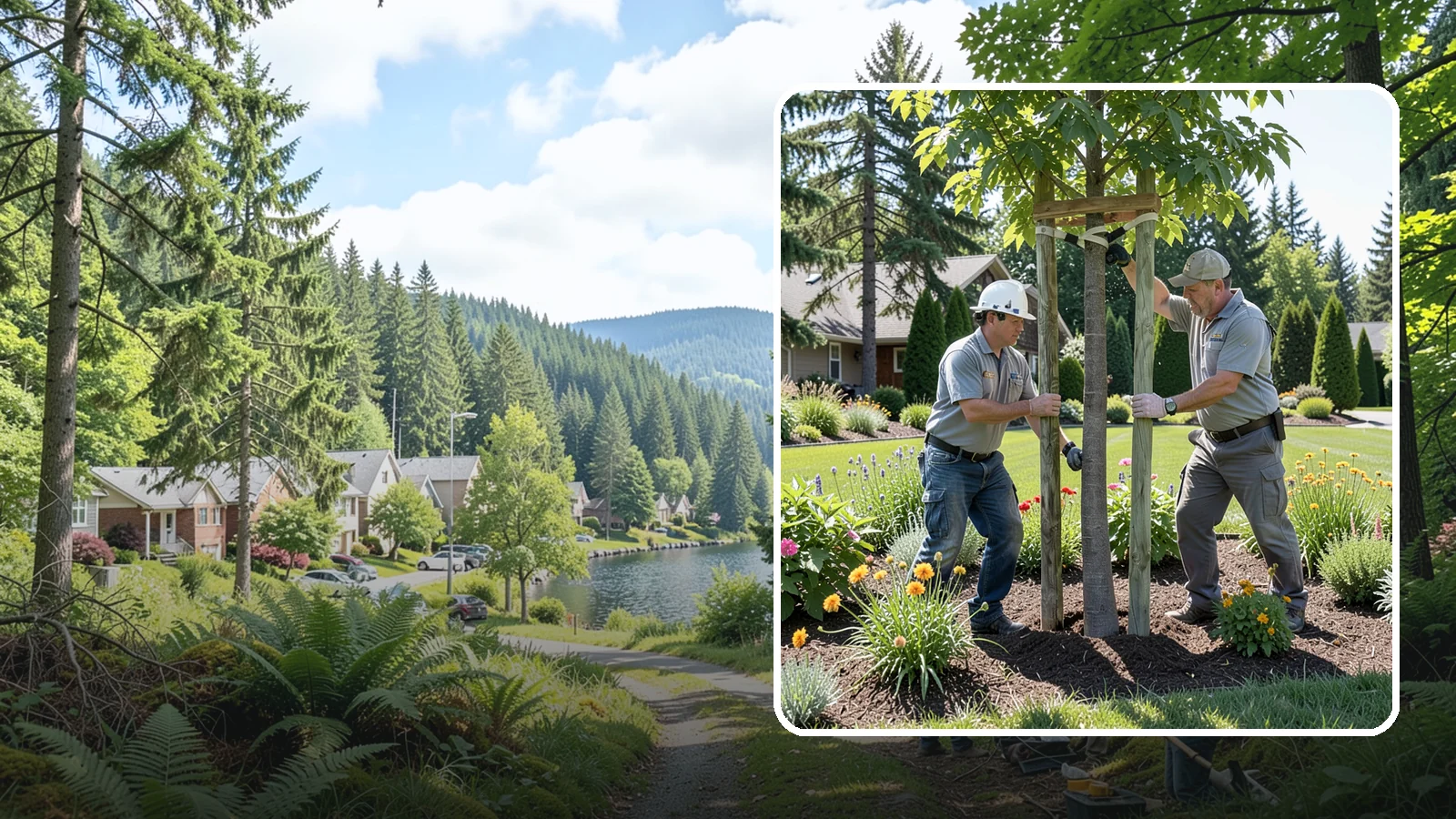
Proper tree staking that steadies new or leaning trees while letting them build real trunk strength.
Tree staking is for Lake Forest Park yards with newly planted trees that lean, sit in open wind, or have a small root ball for the trunk height. It also suits trees that were planted last year and still rock when you push the trunk. Not every tree needs a stake, and a stake left on too long can do harm.
Washington Landscaping has an ISA Certified Arborist on staff, so we can look at the tree and tell you whether staking, a different support, or nothing at all makes sense. Estimates are free. Call or text 425-433-9444.
Staking Options for Lake Forest Park Trees and Soil
There are a few ways to support a young tree. The right one depends on the tree, the site and the season. Here is how they compare.
Your choices
- No stake. A trunk that stands on its own and a root ball that holds firm usually do better without support. Movement helps the trunk build strength.
- Low double stakes with flexible ties. Two stakes sit on opposite sides, with ties that let the trunk sway a little. This is the standard choice for a tree that rocks in its hole or leans in open wind.
- Three-point guying. Straps run from the trunk to anchors in the ground. It suits larger trees, or trees where stakes would be in the way of mowing or foot traffic.
- Underground root ball anchoring. Anchors hold the root ball down, with nothing above ground. It looks cleaner, but it is harder to adjust later.
What local conditions favor
Per the USDA soil survey, about 32% of Lake Forest Park's rated land is well drained and 68% is moderately well drained, with 0% poorly drained. That describes the city as a whole, and your own yard may differ. Where soil drains well, a root ball can settle and hold, so short-term support often works. Moderately well drained soil can stay soft longer after rain.
That matters because 81% of the yearly precipitation falls from October to April (Daymet, 2005-2025). Wet soil and winter wind are when a young tree is most likely to loosen or tilt. Staking before the wet season, with ties checked and loosened as the trunk grows, is the usual practice.
Lake Forest Park is in USDA zone 9a, with an average coldest night near 20.9 F. Frost can still come earlier or later than usual in a given year. Choose ties that will not cut into bark when the trunk swells.
Whichever option fits, stakes should come off once the tree stands on its own, often after one or two growing seasons. We can check the tree and set a plan with you.
Lake Forest Park yard conditions at a glance
| USDA hardiness zone (2023) | 9a |
|---|---|
| Last / first frost (median) | Mar 10 / Nov 14 |
| Tree canopy | 42.2% of the city |
| Share of rain October to April | 81% |
| Dry months (under 1.25 in) | July and August |
A year in a Lake Forest Park yard
- Late winter
- Dormant pruning for most deciduous trees and shrubs, before buds break.
- Spring
- Last frost is usually around Mar 10; in 1 year in 10 it comes on or after Mar 30. Plant frost-tender annuals and vegetables after that.
- Early summer
- Check sprinklers and drip lines before July, the start of the dry months here.
- Summer
- July and August average 0.6 in and 0.9 in. Water deeply and less often; mulch beds to hold moisture.
- Fall
- Aerate, overseed and plant trees and shrubs while the soil is warm; first frost is usually around Nov 14. Winterize irrigation before then.
- Winter
- About 30 days a year freeze at night and thaw by day: keep drains, paver joints and wall weep holes clear.
Dates are medians for the city from Daymet 2005-2025; your yard and any given year can differ.
Sources: Daymet daily weather (NASA/ORNL), 2023 USDA Plant Hardiness Zone Map data (PRISM, Oregon State University), USDA SSURGO soil survey, USGS 3DEP elevation, USFS/NLCD tree canopy 2025, US Census ACS 2020-2024.
Lake Forest Park Tree Staking

Local Service Information
Lake Forest Park
A heavily wooded residential city at the north end of Lake Washington.
Benefits
Steadies new or leaning trees during establishment; Flexible ties allow strength-building sway; Stakes set clear of the root ball; Sized for exposed, windy Puget Sound sites; Removal timeline flagged to prevent girdling
Process
Also serving Lake Forest Park
- Tree Inspections in Lake Forest Parkat Washington Tree Services
Get a Free Tree Staking Estimate in Lake Forest Park
Tell us about your project. We’ll review your needs and provide a customized, no-obligation proposal.
Request a Free Consultation
Complete the form or call our team to discuss your project.
On-Site Assessment
We’ll review your property, discuss your goals, and recommend an appropriate solution.
Receive a Customized Proposal
Receive a detailed estimate outlining the proposed work and pricing.