Shaping Your Outdoors. Surpassing Expectations.

Lake Stevens English Laurel Trimming
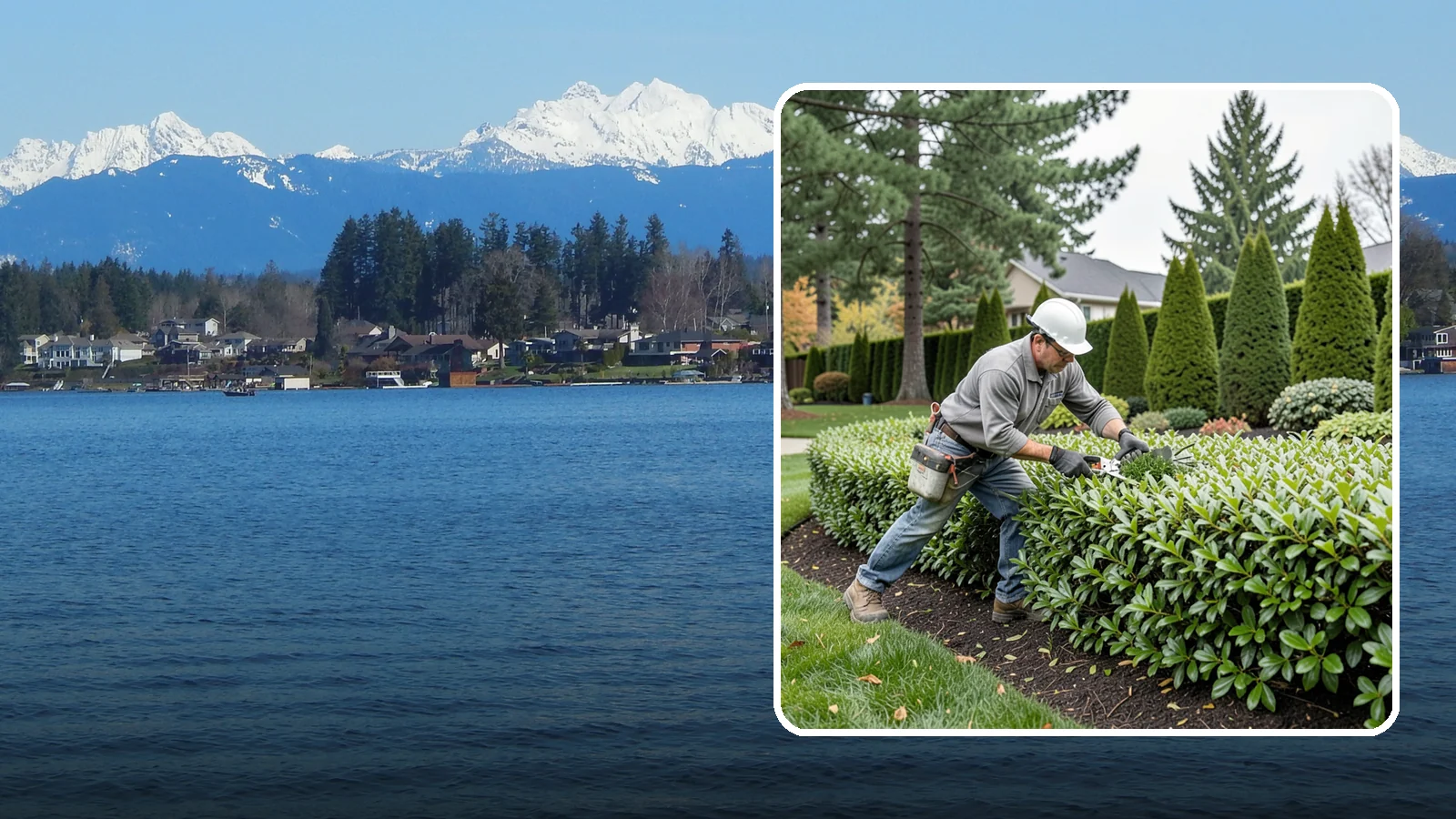
Clean, health-focused English laurel trimming that tames this vigorous broadleaf screen while protecting its large glossy leaves.
The English laurel along your fence line has gotten tall and wide. It blocks light from a window, leans over the sidewalk, or has gone bare and leggy at the base. Big leaves are scattered across the lawn, and the hedge looks ragged where it was last cut.
Washington Landscaping trims English laurel for Lake Stevens homeowners. This page explains why laurel gets out of hand, what timing makes sense here, and how a proper trim is done. Free estimates are available if you want someone to look at the hedge first.
English Laurel Trimming in Lake Stevens: Timing and Method
English laurel grows fast and sprouts back from old wood. That is why it makes a good screen and also why it overgrows. Left alone, it gets taller and wider each year. The outer leaves shade the inside, so the base thins out and the hedge turns hollow.
Timing matters in Lake Stevens. The median frost-free growing season is about 225 days, from about Mar 24 to Nov 10 (Daymet, 2005-2025). Frost can come earlier or later in any given year. Laurel has a long window to push new growth, so one trim often is not enough for a tight hedge. A hedge kept at a set width may need another light shaping later in the season.
July is the dry month here, with about 0.74 in of rain on average. Heavy cutting in midsummer exposes inner leaves to sun and can stress a hedge that gets no water. If your laurel is on a dry slope or has no irrigation, a hard cut in the dry stretch is a poor choice. Water after trimming if the weather is dry.
Tree canopy covers about 31.4% of Lake Stevens (USFS/NLCD 2025). That is a citywide figure, and your yard may differ. If your laurel sits under larger trees, it may already be leggy from shade. In that case, a hard reduction can leave bare stems that are slow to fill in. We would look at how much green growth is on the branches before deciding how far to cut.
How the trim is done
Laurel has large leaves, so hedge shears and power trimmers chop them in half and leave brown, ragged edges. Hand pruners cut cleanly just above a leaf node. For big hedges, we often use a mix: power tools for the bulk shape and hand pruning for the visible faces. We cut the top narrower than the base so light reaches the lower branches. Debris is cleaned up afterward.
Washington Landscaping has an ISA Certified Arborist on staff, which helps when a laurel has grown into a tree-size screen or sits near power lines or structures. Call or text 425-433-9444 for a free estimate.
Lake Stevens yard conditions at a glance
| USDA hardiness zone (2023) | 8b |
|---|---|
| Last / first frost (median) | Mar 24 / Nov 10 |
| Tree canopy | 31.4% of the city |
| Share of rain October to April | 78% |
| Dry months (under 1.25 in) | July |
A year in a Lake Stevens yard
- Late winter
- Dormant pruning for most deciduous trees and shrubs, before buds break.
- Spring
- Last frost is usually around Mar 24; in 1 year in 10 it comes on or after Apr 12. Plant frost-tender annuals and vegetables after that.
- Early summer
- Check sprinklers and drip lines before July, the start of the dry months here.
- Summer
- July average 0.7 in. Water deeply and less often; mulch beds to hold moisture.
- Fall
- Aerate, overseed and plant trees and shrubs while the soil is warm; first frost is usually around Nov 10. Winterize irrigation before then.
- Winter
- About 40 days a year freeze at night and thaw by day: keep drains, paver joints and wall weep holes clear.
Dates are medians for the city from Daymet 2005-2025; your yard and any given year can differ.
Sources: Daymet daily weather (NASA/ORNL), 2023 USDA Plant Hardiness Zone Map data (PRISM, Oregon State University), USDA SSURGO soil survey, USGS 3DEP elevation, USFS/NLCD tree canopy 2025, US Census ACS 2020-2024.
Lake Stevens English Laurel Trimming
Local Service Information
Lake Stevens
A city surrounding the lake of the same name in central Snohomish County.
Benefits
Controls vigorous, fast annual growth; Keeps large leaves whole and glossy instead of shredded; Tolerates hard renewal cuts thanks to strong regrowth; Improves airflow to reduce shot-hole and mildew; Restores clean, defined edges on overgrown screens
Process
English Laurel Trimming in nearby areas
Also serving Lake Stevens
- Structural pruning in Lake Stevensat Washington Tree Services
Get a Free English Laurel Trimming Estimate in Lake Stevens
Tell us about your project. We’ll review your needs and provide a customized, no-obligation proposal.
Request a Free Consultation
Complete the form or call our team to discuss your project.
On-Site Assessment
We’ll review your property, discuss your goals, and recommend an appropriate solution.
Receive a Customized Proposal
Receive a detailed estimate outlining the proposed work and pricing.