Shaping Your Outdoors. Surpassing Expectations.

Roy Concrete Driveway Installation
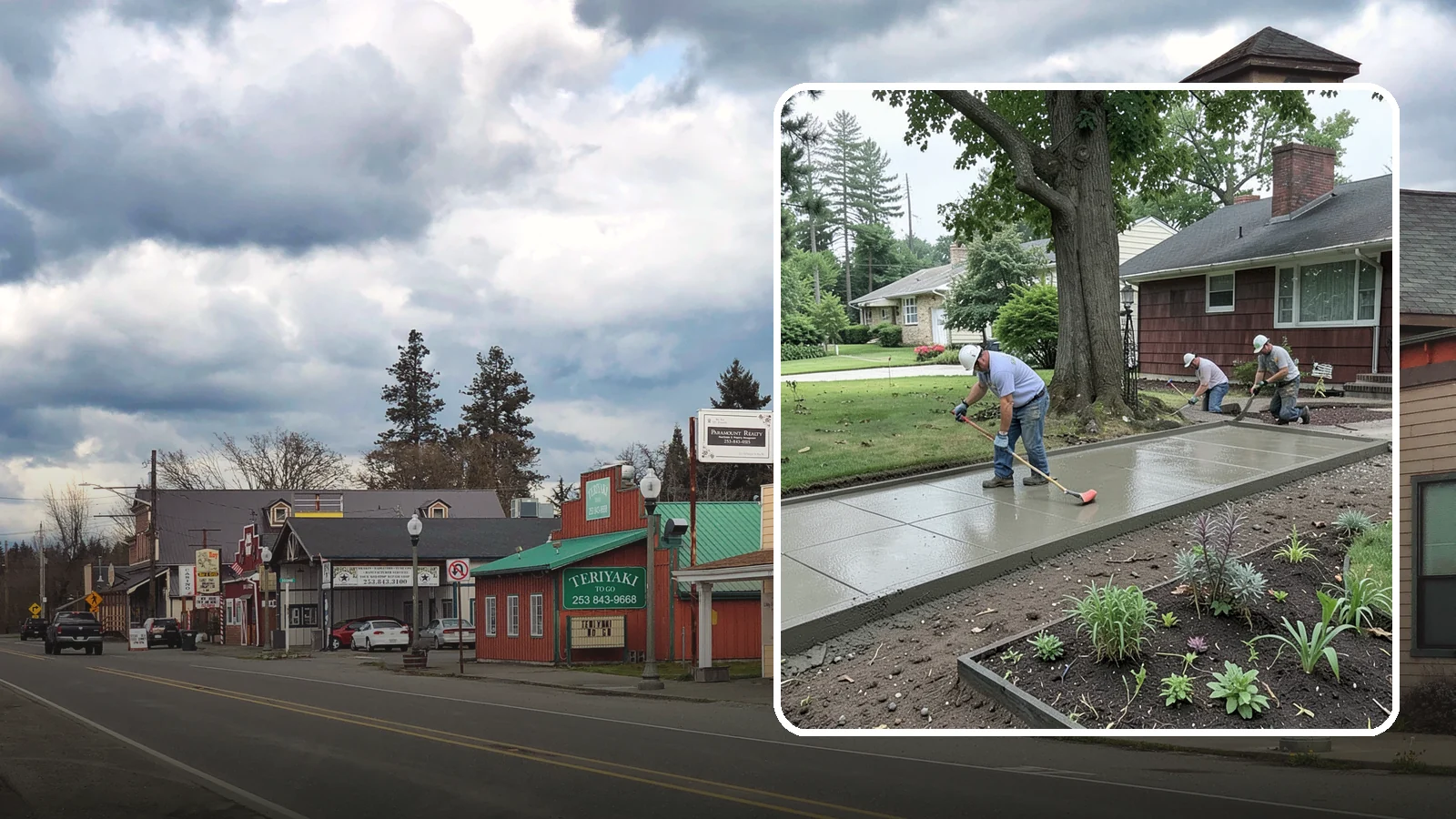
We install thick, reinforced concrete driveways engineered to carry vehicle loads over the region’s soft, saturated soils.
Your old driveway may be cracking, sinking in spots, or holding puddles after a storm. Maybe the gravel or asphalt has worn out and you want something that lasts. A new concrete driveway is one way to fix that, but it only works if the ground under it is built right.
Washington Landscaping installs concrete driveways in Roy, WA. This page explains what causes concrete to fail, what Roy's weather and soil mean for your project, and how the work is done. Free estimates are available, and hardscaping work carries a 1-year workmanship warranty.
How Roy's Weather and Soil Shape a Concrete Driveway
Most driveway cracking starts below the surface. Concrete is hard but not flexible. If the base underneath settles, holds water, or shifts, the slab bends and cracks. Water is the usual cause, and freezing makes it worse.
Freeze and thaw in Roy
Per Daymet climate data, Roy sees about 43 days a year when temperatures freeze at night and thaw by day. Those are medians over many years, so a given winter can bring more or fewer. When water gets into small pores or cracks and freezes, it expands and widens the opening. That is why a driveway here needs a compacted gravel base that drains, and a concrete mix and finish suited to freezing weather. Joints are cut so the slab cracks along planned lines instead of randomly.
Rain and drainage
Daymet data for 2005 to 2025 shows about 46.4 inches of rain a year in Roy, but only about 5.8 days with an inch or more. So the issue is less about constant downpours and more about occasional heavy days that send a lot of water across the surface at once. The driveway needs a slight slope so water moves off it and away from your garage and foundation, not toward them.
Soil
The USDA soil survey (SSURGO) rates about 4% of Roy's land as poorly drained. That describes the city as a whole, and your own yard may differ. A low spot or soft area near your driveway is worth pointing out at the estimate. Wetter ground may call for a deeper base or added drainage.
What the work involves
The work starts by marking the layout and removing the old surface. Next comes excavation to the needed depth, then grading and compacting the base. Forms are set to hold the slab edges and slope. Concrete is poured, leveled, finished, and jointed, then left to cure before it takes vehicle weight. If the project includes grading changes or other structures, permit needs are checked with the city before work starts.
Roy yard conditions at a glance
| Days that freeze at night and thaw by day | 43 a year |
|---|---|
| Land sloping 15% or more | 3% (40% or more: 0%) |
| Days with 0.1 in or more of rain | 117 a year |
| Soil drainage (rated land) | 96% well, 0% moderately well, 4% poorly drained |
| Elevation range | 309 to 402 ft |
A year in a Roy yard
- Late winter
- Dormant pruning for most deciduous trees and shrubs, before buds break.
- Spring
- Last frost is usually around Apr 4; in 1 year in 10 it comes on or after Apr 20. Plant frost-tender annuals and vegetables after that.
- Early summer
- Check sprinklers and drip lines before July, the start of the dry months here.
- Summer
- July and August average 0.5 in and 0.9 in. Water deeply and less often; mulch beds to hold moisture.
- Fall
- Aerate, overseed and plant trees and shrubs while the soil is warm; first frost is usually around Nov 8. Winterize irrigation before then.
- Winter
- About 43 days a year freeze at night and thaw by day: keep drains, paver joints and wall weep holes clear.
Dates are medians for the city from Daymet 2005-2025; your yard and any given year can differ.
How Roy’s soils drain
- Well drained96%
- Moderately well0%
- Poorly drained4%
Share of rated land in the USDA SSURGO soil survey; built-over ground is not rated. A soil check on your lot tells you what you have.
Sources: Daymet daily weather (NASA/ORNL), 2023 USDA Plant Hardiness Zone Map data (PRISM, Oregon State University), USDA SSURGO soil survey, USGS 3DEP elevation, USFS/NLCD tree canopy 2025, US Census ACS 2020-2024.
Roy Concrete Driveway Installation

Local Service Information
Roy
A very small city on the prairies of rural south Pierce County.
Benefits
Increased slab thickness supports vehicle and truck loads; Deep compacted base resists settling in wet soils; Reinforcement bridges soft spots and reduces cracking; Engineered drainage protects the sub-base year-round; Expansion joints accommodate seasonal ground movement

Process

Concrete Driveway Installation in nearby areas
Also serving Roy
- Concrete Repair in Royat Washington Construction
- Concrete Pad Cleaning in Royat Washington Pressure Washing
Get a Free Concrete Driveway Installation Estimate in Roy
Tell us about your project. We’ll review your needs and provide a customized, no-obligation proposal.
Request a Free Consultation
Complete the form or call our team to discuss your project.
On-Site Assessment
We’ll review your property, discuss your goals, and recommend an appropriate solution.
Receive a Customized Proposal
Receive a detailed estimate outlining the proposed work and pricing.