Shaping Your Outdoors. Surpassing Expectations.

Tacoma Stone Wall Installation
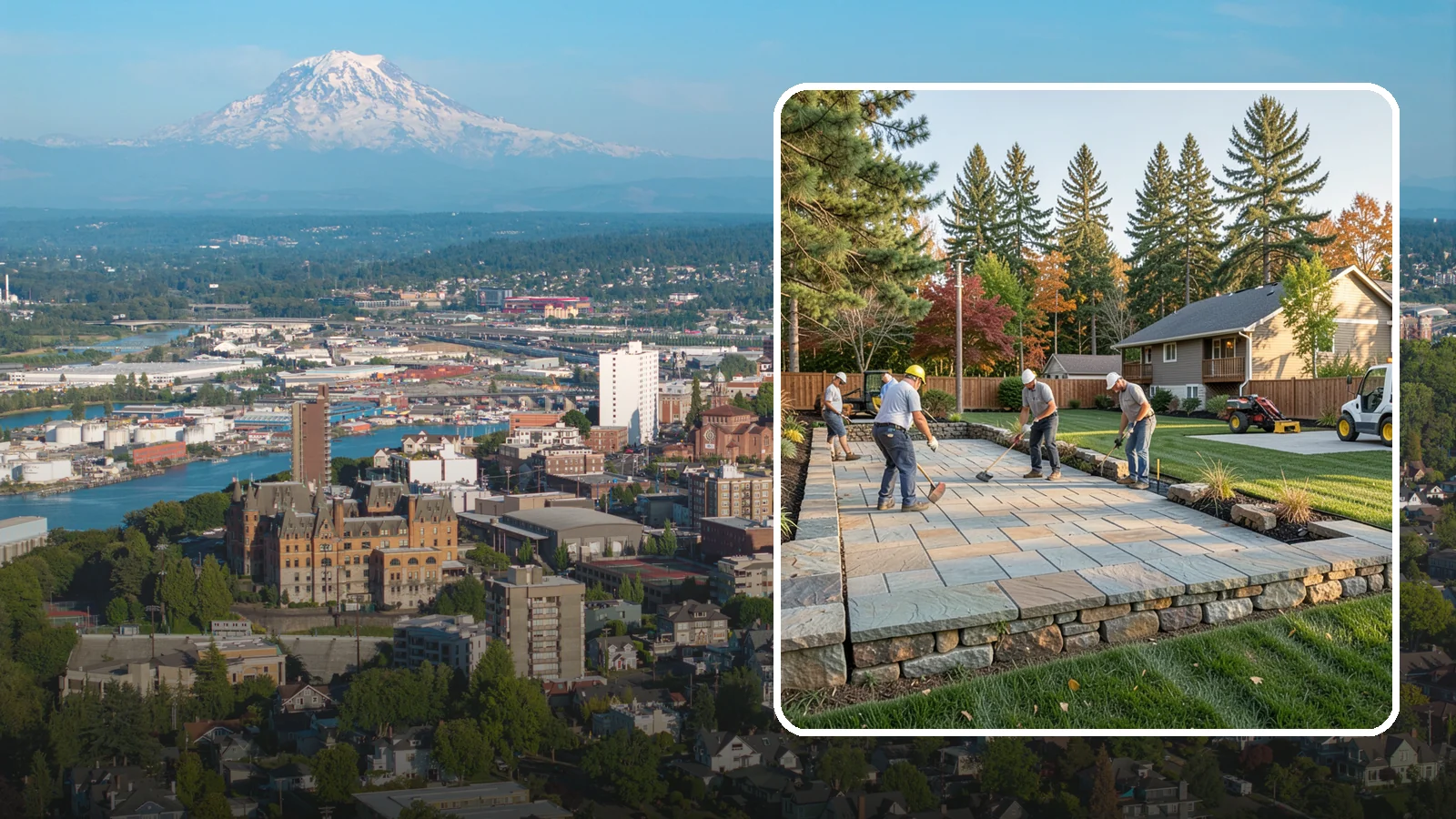
We construct natural stone walls that combine timeless appearance with the drainage needed for wet-climate durability.
You may be looking at a slope in your Tacoma yard where soil creeps downhill, a flower bed keeps washing out, or a section of lawn is too steep to mow comfortably. A stone wall can hold that ground in place and give you level space to use.
Washington Landscaping, based in Bothell, WA, builds stone walls as part of its hardscaping work. Free estimates are available, and hardscaping carries a 1-year workmanship warranty. Below is what Tacoma conditions mean for a wall and how the work goes.
How Tacoma's slopes and freeze-thaw affect a stone wall
A retaining wall has one job: hold back soil that wants to move. Soil pushes harder when it is wet, and water that cannot escape builds pressure behind the wall. Most wall failures trace back to poor drainage or a weak base, not the stone itself.
Slope is the first local factor. Per USGS 3DEP elevation data, about 11% of Tacoma's land slopes 15% or more. That describes the city as a whole. Your own yard may be flatter or steeper, so the grade on your lot is what matters. On a steep lot, a wall may need to be taller or built in tiers, and that is where a permit check becomes important.
Freeze and thaw is the second factor. Daymet data shows about 31 days a year in Tacoma when temperatures freeze at night and thaw by day. Water that gets into the soil or between stones expands as it freezes and can push a wall out of line over the years. Frost can arrive earlier or later in any given year, so this is an average, not a forecast. The answer is a compacted gravel base, clean drainage stone behind the wall, and a way for water to leave, such as perforated pipe. Those are standard practice in the Puget Sound region.
What the work looks like
Planning starts with a visit to look at the slope, the soil, and where water runs. Because walls and grading can trigger permit rules, we check permit needs with the city before work starts. We cannot promise an outcome on that, and the requirements depend on your site.
Then crews excavate for the base, compact the gravel, and set the first course carefully, since every course above depends on it. Stone is stacked and backfilled with drainage rock as the wall rises. If you plan to plant above or below the wall, note that Tacoma sits in USDA zone 8b, with parts of the city from 8b to 9a, which helps when choosing plants for the planting beds.
Call or text 425-433-9444 to ask for a free estimate. Financing is available, subject to credit approval.
Tacoma yard conditions at a glance
| Days that freeze at night and thaw by day | 31 a year |
|---|---|
| Land sloping 15% or more | 11% (40% or more: 2.9%) |
| Days with 0.1 in or more of rain | 118 a year |
| Soil drainage (rated land) | 17% well, 75% moderately well, 7% poorly drained |
| Elevation range | -5 to 445 ft |
A year in a Tacoma yard
- Late winter
- Dormant pruning for most deciduous trees and shrubs, before buds break.
- Spring
- Last frost is usually around Mar 20; in 1 year in 10 it comes on or after Apr 8. Plant frost-tender annuals and vegetables after that.
- Early summer
- Check sprinklers and drip lines before July, the start of the dry months here.
- Summer
- July and August average 0.5 in and 0.9 in. Water deeply and less often; mulch beds to hold moisture.
- Fall
- Aerate, overseed and plant trees and shrubs while the soil is warm; first frost is usually around Nov 14. Winterize irrigation before then.
- Winter
- About 31 days a year freeze at night and thaw by day: keep drains, paver joints and wall weep holes clear.
Dates are medians for the city from Daymet 2005-2025; your yard and any given year can differ.
How Tacoma’s soils drain
- Well drained17%
- Moderately well75%
- Poorly drained7%
Share of rated land in the USDA SSURGO soil survey; built-over ground is not rated. A soil check on your lot tells you what you have.
Sources: Daymet daily weather (NASA/ORNL), 2023 USDA Plant Hardiness Zone Map data (PRISM, Oregon State University), USDA SSURGO soil survey, USGS 3DEP elevation, USFS/NLCD tree canopy 2025, US Census ACS 2020-2024.
Tacoma Stone Wall Installation
Local Service Information
Tacoma
The Pierce County seat and a major port city on Commencement Bay of Puget Sound.
Benefits
Timeless natural stone appearance that ages gracefully; Integrated drainage protects retaining applications; Freeze-thaw-conscious construction resists movement; Durable materials suited to wet Northwest conditions; Custom fitting for a solid, hand-crafted result

Process
Stone Wall Installation in nearby areas
Also serving Tacoma
- Concrete Removal in Tacomaat Washington Construction
- Concrete Cleaning in Tacomaat Washington Pressure Washing
Get a Free Stone Wall Installation Estimate in Tacoma
Tell us about your project. We’ll review your needs and provide a customized, no-obligation proposal.
Request a Free Consultation
Complete the form or call our team to discuss your project.
On-Site Assessment
We’ll review your property, discuss your goals, and recommend an appropriate solution.
Receive a Customized Proposal
Receive a detailed estimate outlining the proposed work and pricing.