Shaping Your Outdoors. Surpassing Expectations.

Tukwila Footing Drain Installation
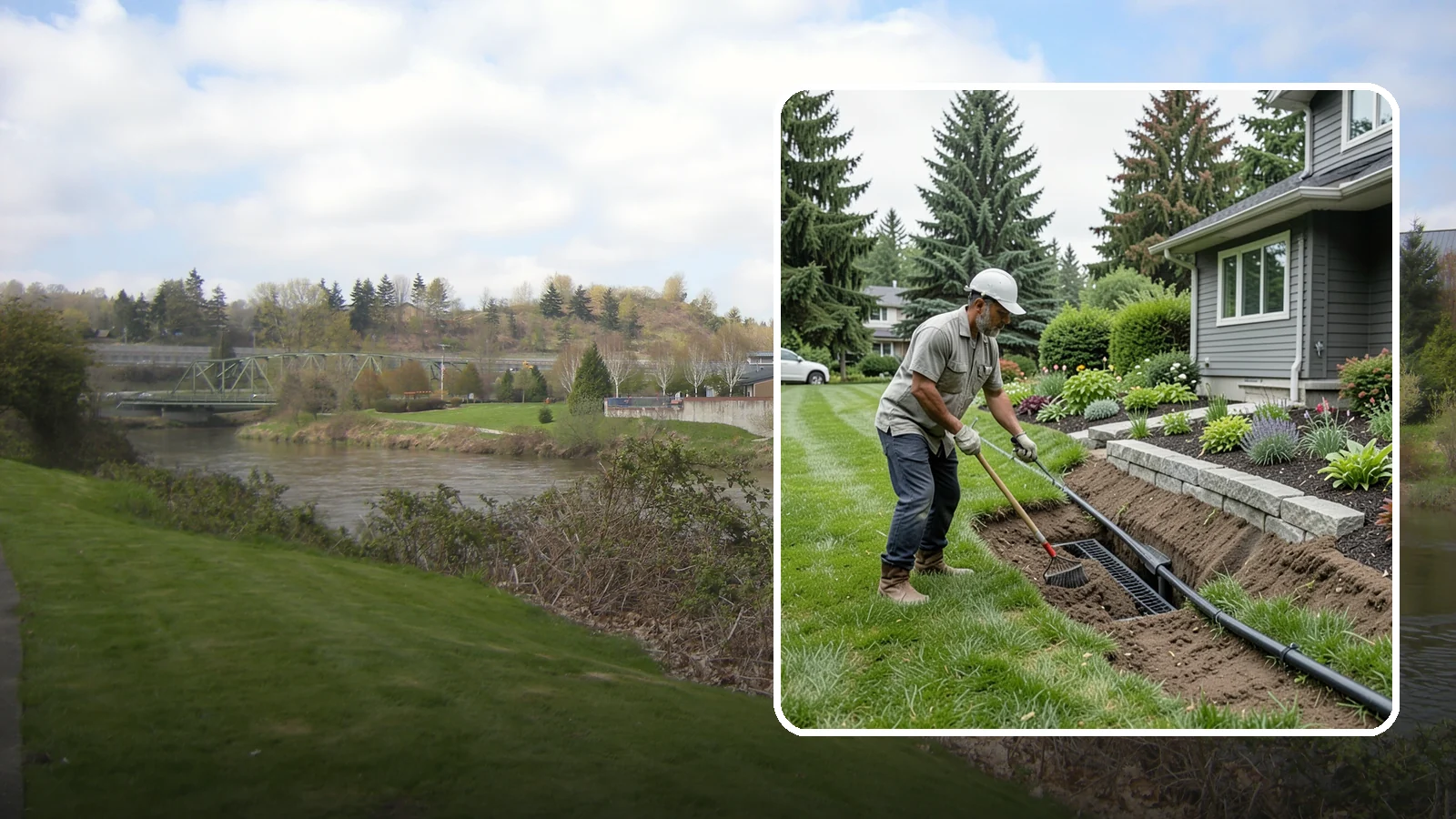
We install perimeter footing drains around your foundation to collect subsurface water and keep it away from basement and crawl-space walls.
You notice damp spots along the basement wall after a rain. Maybe there is a musty smell, white mineral staining on the concrete, or water pooling beside the foundation for days. These are common signs that water is collecting at the footing instead of moving away from the house.
A footing drain gives that water a path out. Washington Landscaping installs footing drains for Tukwila homeowners, and the free estimate is a good place to start. We look at where the water goes, how the ground slopes, and whether a drain is the right fix for your house.
Why Footing Drains Matter for Tukwila Homes
Water against a foundation comes from two sources: rain running off the roof and ground, and groundwater held in the soil. When soil around the footing stays saturated, water pushes through cracks, joints and porous concrete. A footing drain relieves that pressure by collecting water at the base of the foundation and carrying it away.
Local conditions make this worth thinking about. Per the USDA soil survey, about 16% of Tukwila's rated land is poorly drained. That figure describes the city as a whole, so your own yard may be better or worse. Poorly drained soil holds water longer, which keeps the ground around a footing wet.
Timing matters too. Daymet data for 2005 to 2025 shows about 82% of Tukwila's yearly precipitation falls from October to April. That means the soil often stays wet for months at a stretch, with little chance to dry out. If a basement or crawlspace is damp, it is usually worst in that season.
Age of the home is another factor. Census ACS data for 2020 to 2024 shows about 48% of Tukwila housing units were built before 1980, though that count includes apartments. Older houses may have no footing drain at all, or an original one that has clogged over time. We can't know what your house has until it is inspected.
The work itself is straightforward to describe. We excavate along the foundation, set perforated pipe in drain rock at the footing, and wrap it in fabric so soil does not clog it. The pipe is sloped to a suitable outlet. Then we backfill and restore the area as agreed. Because digging this close to a structure needs care, we plan the route, utilities and outlet before starting.
Call or text 425-433-9444 to set up a free estimate. Washington Landscaping has been in business since 2004 and is licensed, bonded and insured ($2M). Financing is available, subject to credit approval.
Tukwila yard conditions at a glance
| Soil drainage (rated land) | 35% well, 49% moderately well, 16% poorly drained |
|---|---|
| Days with 1 in or more of rain | 4.5 a year |
| Share of rain October to April | 82% |
| Land sloping 15% or more | 19% (40% or more: 2.8%) |
| Average yearly precipitation | 39.8 in |
A year in a Tukwila yard
- Late winter
- Dormant pruning for most deciduous trees and shrubs, before buds break.
- Spring
- Last frost is usually around Mar 11; in 1 year in 10 it comes on or after Mar 27. Plant frost-tender annuals and vegetables after that.
- Early summer
- Check sprinklers and drip lines before July, the start of the dry months here.
- Summer
- July and August average 0.5 in and 0.8 in. Water deeply and less often; mulch beds to hold moisture.
- Fall
- Aerate, overseed and plant trees and shrubs while the soil is warm; first frost is usually around Nov 17. Winterize irrigation before then.
- Winter
- About 26 days a year freeze at night and thaw by day: keep drains, paver joints and wall weep holes clear.
Dates are medians for the city from Daymet 2005-2025; your yard and any given year can differ.
How Tukwila’s soils drain
- Well drained35%
- Moderately well49%
- Poorly drained16%
Share of rated land in the USDA SSURGO soil survey; built-over ground is not rated. A soil check on your lot tells you what you have.
Sources: Daymet daily weather (NASA/ORNL), 2023 USDA Plant Hardiness Zone Map data (PRISM, Oregon State University), USDA SSURGO soil survey, USGS 3DEP elevation, USFS/NLCD tree canopy 2025, US Census ACS 2020-2024.
Tukwila Footing Drain Installation

Local Service Information
Tukwila
A city in the Green/Duwamish river valley of south King County, a major retail and commercial hub.
Benefits
Relieves hydrostatic pressure on foundation walls; Keeps basements and crawl spaces dry; Prevents long-term moisture and structural damage; Wrapped gravel envelope resists silting; Critical protection in saturated PNW soils

Process
Also serving Tukwila
- Slab Foundation Installation in Tukwilaat Washington Construction
- Aluminum Gutters in Tukwilaat Washington Roofing
Get a Free Footing Drain Installation Estimate in Tukwila
Tell us about your project. We’ll review your needs and provide a customized, no-obligation proposal.
Request a Free Consultation
Complete the form or call our team to discuss your project.
On-Site Assessment
We’ll review your property, discuss your goals, and recommend an appropriate solution.
Receive a Customized Proposal
Receive a detailed estimate outlining the proposed work and pricing.