Shaping Your Outdoors. Surpassing Expectations.

Tukwila Lawn Fertilization
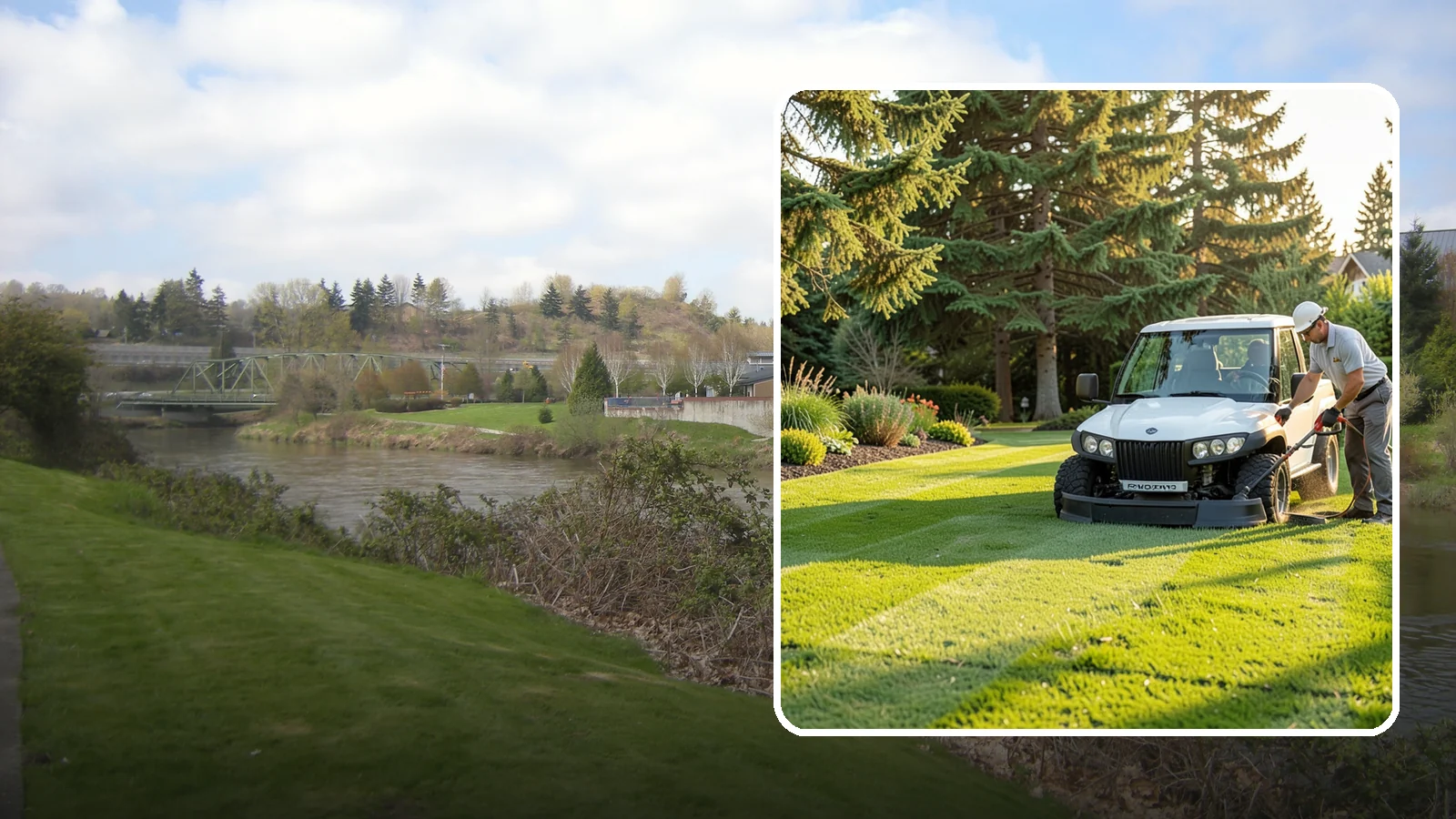
Season-timed fertilization that feeds your lawn for thick, green, resilient growth.
Your lawn looks thin and pale, or it greens up in patches while moss and weeds fill the gaps. Maybe the grass never quite recovered from last summer. In Tukwila, that often points to a lawn that is not getting the nutrients it needs at the right times.
Lawn fertilization feeds the grass on a schedule that fits how it grows. Washington Landscaping holds a Washington State pesticide applicator license, and we offer free estimates if you want someone to look at your lawn first.
How Lawn Fertilization Works in Tukwila, WA
Grass pulls nutrients from the soil every time it grows. Clippings, rain and irrigation all remove some of them. Over a few seasons, a lawn that is never fed can slow down, thin out and lose color. Thin turf also leaves room for moss and weeds to move in.
Why timing matters here
Fertilizer only helps when the grass is actively growing. Tukwila's median last spring frost (32 F) falls on Mar 11, and the median first fall frost falls on Nov 17, per Daymet data for 2005-2025. That gives a frost-free growing season of about 247 days. These are medians, so frost can arrive earlier or later in any given year.
A long season means the lawn has many months to use nutrients. It also means a single feeding will not last the whole year. Spreading applications across the growing season is standard practice in the Puget Sound region. Early spring and early fall are common times to feed, and a lighter approach in the dry heat of midsummer is usual, since stressed grass does not use fertilizer well.
What the work looks like
We start by looking at the lawn: its color, density, thatch, moss and any bare areas. Soil conditions vary from yard to yard, even within one city, so what your neighbor's lawn needs may not match yours. Compacted ground, shade and poor drainage can all hold a lawn back, and fertilizer alone will not fix those. If we see one of them, we will tell you.
Then we apply a fertilizer matched to the season and the condition of the turf. Even spreading matters. Missed strips show up as pale stripes, and overlap can burn the grass. Where weeds need control, that is handled as a separate step by a licensed applicator.
You can help between visits by mowing at a higher setting, leaving clippings on the lawn and watering deeply but not often. To ask about a plan for your yard, call or text 425-433-9444. Financing is available subject to credit approval.
Tukwila yard conditions at a glance
| Days with 0.1 in or more of rain | 104 a year |
|---|---|
| Tree canopy | 19.3% of the city |
| Frost-free season | about 247 days |
| Share of rain October to April | 82% |
| Last / first frost (median) | Mar 11 / Nov 17 |
A year in a Tukwila yard
- Late winter
- Dormant pruning for most deciduous trees and shrubs, before buds break.
- Spring
- Last frost is usually around Mar 11; in 1 year in 10 it comes on or after Mar 27. Plant frost-tender annuals and vegetables after that.
- Early summer
- Check sprinklers and drip lines before July, the start of the dry months here.
- Summer
- July and August average 0.5 in and 0.8 in. Water deeply and less often; mulch beds to hold moisture.
- Fall
- Aerate, overseed and plant trees and shrubs while the soil is warm; first frost is usually around Nov 17. Winterize irrigation before then.
- Winter
- About 26 days a year freeze at night and thaw by day: keep drains, paver joints and wall weep holes clear.
Dates are medians for the city from Daymet 2005-2025; your yard and any given year can differ.
Sources: Daymet daily weather (NASA/ORNL), 2023 USDA Plant Hardiness Zone Map data (PRISM, Oregon State University), USDA SSURGO soil survey, USGS 3DEP elevation, USFS/NLCD tree canopy 2025, US Census ACS 2020-2024.
Tukwila Lawn Fertilization
Local Service Information
Tukwila
A city in the Green/Duwamish river valley of south King County, a major retail and commercial hub.
Benefits
Thicker greener grass that crowds out weeds; Stronger roots and better drought and stress tolerance; Balanced nutrition timed to the season; Reduced moss and weed pressure over time; A multi-application program tailored to your lawn
Process

Get a Free Lawn Fertilization Estimate in Tukwila
Tell us about your project. We’ll review your needs and provide a customized, no-obligation proposal.
Request a Free Consultation
Complete the form or call our team to discuss your project.
On-Site Assessment
We’ll review your property, discuss your goals, and recommend an appropriate solution.
Receive a Customized Proposal
Receive a detailed estimate outlining the proposed work and pricing.